
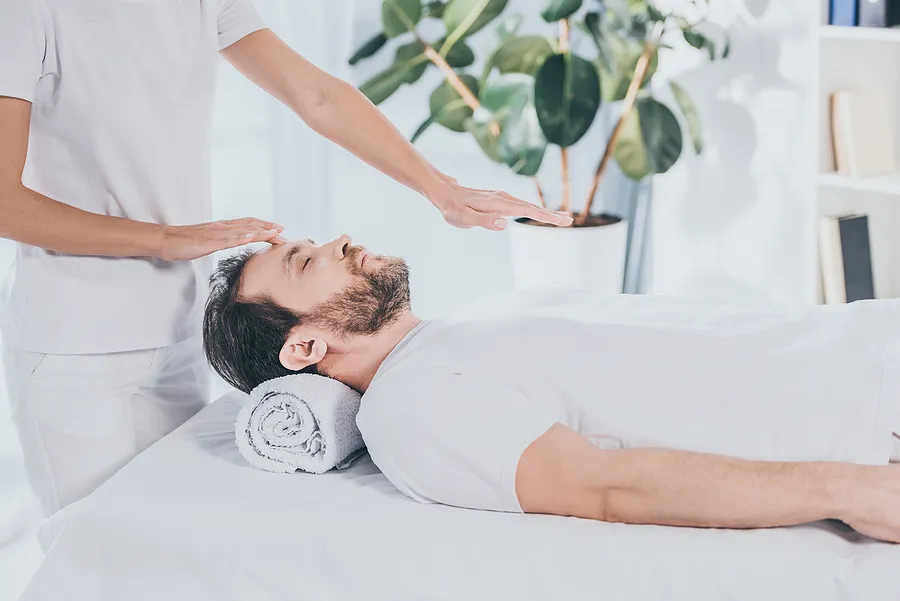
Most people who end up practicing Reiki professionally did not set out to. They went to a session for their own reasons, felt something they could not quite explain, and found themselves wondering — quietly at first — whether they could learn to do that.
If that describes you, this guide covers the whole path: what the training levels actually are, what happens in a class, what an attunement is, how long it takes, what it costs, how to choose a teacher, and what it takes to move from “I’ve learned Reiki” to “this is my practice.”
The International Association of Reiki Professionals has been supporting Reiki practitioners, Master Teachers, and students worldwide since 1996. What follows is a concise map — including the parts of the journey nobody tells you about ahead of time.
First, an important thing to understand about the field
Reiki Training quality can vary enormously. Training ranges from thoughtful year-long apprenticeships to certificates issued after a two-hour online video. Both produce a piece of paper that says “Reiki Master.”
The second is that the burden of choosing well falls entirely on you — and later, on your clients when they choose you. This is exactly why professional standards, ethics agreements, and continuing education matter more in Reiki than in some other fields. It is also why the practitioners and teachers who take those things seriously stand out. [LINK: reiki-certification-explained] And it is precisely why IARP Reiki Professional Members are a standout in the field of Reiki.
The three levels of Reiki training
Reiki is traditionally taught in three levels, though the names and details vary between lineages.
Level I (First Degree) — practice for yourself
Level I is the foundation. It focuses on self-treatment and offering Reiki to family and friends. You will typically learn the history of the practice, the precepts, the standard hand positions for treating yourself and others, and the basics of grounding and self-care. Most Level I classes run one sometimes two days.
The traditional emphasis at this level is important and often overlooked: Level I is about establishing a daily personal practice. Teachers commonly ask students to complete 21 consecutive days of self-treatment after the class.
Many people stop here, and that is a complete and legitimate path. Reiki as a personal practice for your own wellbeing is not a lesser version of the thing.
Level II (Second Degree) — the professional threshold
Level II is where the training turns outward. You will typically learn the first Reiki symbols, distance practice, and how to work with people beyond your immediate circle. This is the level most practitioners hold before working with clients, and it is the minimum level IARP expects.
Some traditional teachers require a waiting period between Level I and Level II — sometimes traditionally even three to six months — so that the personal practice has time to settle. Classes usually run one to two days. This waiting period has shortened in recent years depending on the teacher.
If your goal is to work with clients, Level II is your target.
Master / Teacher level — teaching and initiating others
The Master level, sometimes split into Master Practitioner and Master Teacher and sometimes called Reiki III and Reiki IV, confers the ability to attune and teach others.
It is recommended taking some time to practice Reiki after Level II before delving into Master training. This allows you demonstrated experience and time for the Reiki to evolve you into your best version of a practitioner before going on to learning how to teach. You want to be able to do effectively and then, if called, to teach knowledgeably.
It typically includes the master symbol, attunement procedures, and — in the best programs — substantial training in how to actually teach: curriculum design, holding a classroom, assessing readiness, and the ethics of taking on students. If you have not learned this in your Reiki Teacher curriculum, IARP can help you with this with our upcoming continuing education for IARP Professional Member to hone and advance your skills. Be in the know about this new offering to help bring your Reiki classes to the next level.
What is an attunement?
Every level of Reiki training includes an attunement (also called a placement, initiation, or reiju depending on the tradition) — a short ceremony conducted by the teacher, traditionally understood to open or strengthen the student’s capacity to channel Reiki.
Practically, it takes a few minutes. You sit quietly, usually with your eyes closed and hands in a prayer position, while the teacher moves around you performing a sequence of gestures. Some people report warmth, colors, emotion, or a sense of expansion; some feel nothing in particular. Neither response means anything about whether it “took.”
Teachers commonly describe a “clearing” period of about 21 days afterward, during which students may notice emotional sensitivity, vivid dreams, or positive shifts in energy. Whether you experience this or not, the useful practice during that window is the same: daily self-treatment and gentle attention.
On distance attunements: whether attunements can be given remotely is one of the most genuinely debated questions in the Reiki world. Many respected teachers now offer them online and consider them fully effective; others hold that attunement should be given in person. Both positions are held sincerely by experienced practitioners and it is a personal choice and offering. Ask a prospective teacher how they do it and the reasons why.
How long does it take, and what does it cost?
There is no standard answer, but here are realistic ranges.
Timeline. This varies within lineages and teachings. Ask your Reiki Teacher for their guidance on timeframes. And listen to your own intuition when choosing the best teacher for you and the timeline path that feels right to you. If you plan to offer Reiki professionally this may be a longer timeline than if you plan to use Reiki as a personal practice on yourself and family only.
Cost. Class fees vary by region, lineage, and teacher experience. Broadly: Level I commonly runs USD$150–$400, Level II $200–$500, and Master level $500–$1,500 or more. Higher prices do not guarantee better teaching, and low prices are worth asking questions about. Some teachers offer payment plans or sliding scales — it is entirely reasonable to ask.
Beyond class fees, budget for the things that make a practice real: a massage or treatment table, professional association membership, business registration, professional liability insurance if available, and basic marketing.
How to choose a teacher
A good teacher shapes not just your technique but your ethics, your confidence, and your sense of what this practice is.
Ask about their lineage. Who taught them, and who taught that person? A teacher should be able to trace their line back, ideally to Usui. Not because older is better, but because a teacher who cannot answer has not thought about it.
Ask how long they have practiced and taught. Years in practice matter more than the level on their certificate.
Ask about class size and contact hours. A Level I class with six students and eight hours of contact is a different experience from thirty students and three hours.
Ask what happens after the class. The best teachers offer ongoing support — practice circles, mentoring, a channel for questions. Reiki training is not complete when the class ends as it is an unfolding wisdom and practice.
Ask what you will receive. A manual, a certificate stating your level, and ideally an ongoing relationship if any questions after your training.
Notice how they speak about Reiki’s limits. A teacher who claims Reiki cures disease, or who discourages medical care, will pass that thinking to you — ask questions, choose wisely.
Notice how they speak about other lineages. Confidence is attractive; disparaging other traditions is not.
Find a Professional Reiki Master Teacher or Class near you →
From trained to practicing: what nobody tells you
Here is the gap most new practitioners fall into. You finish Level II feeling capable and moved — and then discover that knowing Reiki and running a practice are two entirely different skills.
The things that actually determine whether you build a practice:
Practice hours. Confidence comes from repetition, not from the certificate. Offer sessions to friends, family, and volunteers. Many practitioners set a target — 10-20 sessions — before charging. Keep a log; you will want the record later. IARP requires 20 hours of session time prior to applying to become a Reiki Practitioner Member.
The professional infrastructure. Liability insurance before your first paying client, if offered in your country, is a good idea. Intake and informed consent forms. Session notes. A clear scope-of-practice statement about what you do and do not claim. Business registration and a simple bookkeeping system.
Knowing your language. How you describe Reiki to a nervous first-time client — and what you must never claim — is a genuine skill, and it protects both of you. Practice these skills before offering sessions.
Being findable. Most new practitioners assume clients will come by word of mouth. Some do. The rest come from being visible where people search — which increasingly means a professional listing, a simple website, and a booking link.
Continuing to learn. The practitioners who succeed treat Level II as a beginning. Going on to Reiki Master is a next step. Becoming certified in Trauma-informed practice, working with oncology patients, hospice care, animals, children — these are specialties that deepen your work and distinguish you.
How IARP can help you be your best
IARP Professional Membership provides a full suite of benefits for Reiki Practitioners and Teachers to excel in their field. A few of the benefits include a professional public directory listing designed to be found by clients or students searching locally for your services, access to professional liability insurance programs where available, business and intake templates, continuing education through the IARP Learning Center, a worldwide community of practitioners, a Code of Ethics that provides you with a professional attainment of highest standards, and a host of professional tools to take your Reiki practice or the quality of your classes to the next level.
Frequently asked questions
Can I learn Reiki online?
Live online instruction or self-paced video is now widely offered and many respected teachers work this way.
Do I need Level II to charge clients?
It is the widely accepted standard, and generally what insurers and IARP requires.
What if my teacher is no longer reachable and I’ve lost my certificate?
This is common. Contact your teacher’s lineage community, or explain the situation when applying for membership — IARP has a process for non-standard or lost documentation.
The first step
If you are still reading, the direct next step is small: take a Level I class with a teacher you have actually spoken to, and commit to twenty-one days of daily self-practice afterward. Everything else — Level II, clients, a practice, perhaps one day teaching — follows from whether that daily practice becomes something you want in your life. Most practitioners will tell you it transformed their lives so much they were called to share the beautiful modality of Reiki.
Find a Reiki Teacher in your area
The International Association of Reiki Professionals has been supporting Reiki practitioners, teachers, and students worldwide since 1996. Let us help you with the tools and professional support to excel in your Reiki offerings.